
Health and Wellness
Advancements in MRI Back & Spine Scans: Enhancing Diagnostic Precision

Table of Contents
- AI Integration in MRI Analysis
- Automated Segmentation and Measurement
- Importance of Patient Symptom Correlation
- Accelerated MRI Techniques
- Upright MRI Imaging
- Future Directions in MRI Diagnostics
Magnetic Resonance Imaging (MRI) remains one of the most essential tools for diagnosing back and spine conditions. Over the past few years, technological advances have greatly increased the speed and reliability of spine imaging. Patients who are experiencing back pain or looking for comprehensive spinal diagnostics are seeing faster and more precise results. For those seeking detailed information about the process, you can learn more about the spine MRI procedure, how it works, and what to expect.
Diagnosing spine and back pain can be challenging, as symptoms often overlap across various conditions. The combination of advanced imaging technologies and machine learning now offers unprecedented diagnostic accuracy, supporting more effective patient care and faster clinical outcomes.
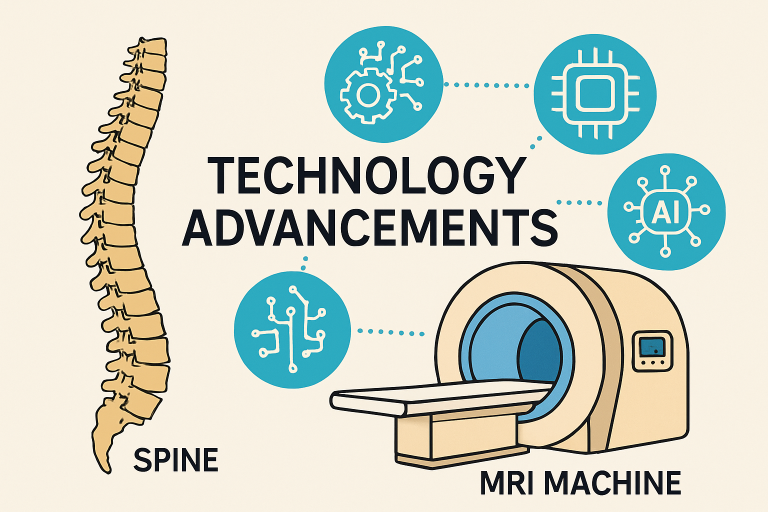
Whether you are a patient or a healthcare professional, understanding how recent advancements in MRI technology are transforming spinal health is crucial. Integrating artificial intelligence (AI), automating certain processes, and offering next-level imaging techniques are reframing how practitioners diagnose and treat spinal problems in clinical practice.
The progress in MRI technology also refines how clinicians correlate imaging findings with patient-reported symptoms, improving individualized treatment plans and minimizing unnecessary interventions. These innovations are making the pathway to relief more direct for those suffering from spine-related pain.
AI Integration in MRI Analysis
Artificial intelligence has become a pivotal force in reading and interpreting lumbar spine MRI images. Medical centers worldwide are now using AI to help radiologists make quicker, more precise decisions. For example, a study from Northwestern Medicine showed that AI-assisted readings can significantly reduce the time radiologists spend reviewing cases. This increase in efficiency allows radiologists to focus more time on complex diagnoses while maintaining a high standard of consistency in their readings. Quicker, more accurate interpretations directly benefit patients by reducing wait times for diagnosis and streamlining their path to treatment. ([beckershospitalreview.com](https://www.beckershospitalreview.com/radiology/ai-boosts-radiologist-productivity-by-15-at-northwestern-medicine/))
Automated Segmentation and Measurement
Deep learning models now enable automated segmentation of complex spinal structures in MRI scans. These models can precisely measure intervertebral disc height and spinal canal diameter, which previously required manual calculation and were prone to human error. As a result, clinicians experience reduced workload while diagnostic reliability and objectivity improve. The ability to process large volumes of data quickly is especially impactful in hospitals and busy clinical environments, as it supports a systematic approach to managing a high number of cases effectively. More about the impact of automation on radiology can be found in reputable medical journals such as Rad AI Reporting.
Importance of Patient Symptom Correlation
Even with the best imaging technology available, meaningful diagnosis of spinal problems requires integrating the patient’s reported symptoms into the evaluation process. There has been a growing emphasis on combining well-documented patient history and standardized symptom questionnaires with detailed MRI findings. Research from institutions such as Harvard Medical School highlights that many incidental findings in spinal imaging may not require treatment unless they align with the patient’s specific complaints. By aligning clinical symptoms with imaging observations, healthcare providers can better identify the exact source of pain, avoid over-treatment, and customize therapeutic strategies for optimal care.
Accelerated MRI Techniques
New MRI protocols powered by AI have enabled dramatic reductions in the time patients spend in the scanner, sometimes by as much as 70 percent. Modern imaging techniques employ sophisticated algorithms to reconstruct high-quality images at a fraction of the time required by traditional scans. These rapid scans are particularly beneficial for patients who have trouble remaining still due to pain or anxiety. Shorter scans not only increase patient comfort but also boost the efficiency of imaging centers by allowing more patients to be seen each day. The resulting gains in workflow and productivity do not come at the expense of image quality or diagnostic reliability, ensuring that both clinicians and patients benefit.
Upright MRI Imaging
Unlike conventional scans conducted with patients lying flat, upright MRI scanning technology enables imaging in natural, weight-bearing positions. This is especially important for conditions that only manifest when the spine is under pressure, such as certain types of spinal compression or instability between vertebrae. Upright MRI has demonstrated value in revealing abnormalities that standard supine scans may miss, aligning the imaging process more closely with real-life dynamics. As this technology becomes more prevalent, patients are enjoying greater comfort and clinicians are gaining a more comprehensive view of spinal mechanics under functional loads.
Future Directions in MRI Diagnostics
Ongoing innovation in spinal imaging is expected to further enhance the precision and personal relevance of MRI diagnostics. Advanced AI algorithms continue to evolve, promising even deeper insights into spinal pathology. At the same time, there is a trend toward integrating comprehensive patient data and imaging results, paving the way for increasingly personalized treatment approaches. Researchers are developing tools to assess the entire spectrum of spinal health: from subtle degenerative changes to acute injuries. These efforts collectively aim to reduce unnecessary procedures, speed recovery times, and deliver better long-term outcomes for patients.
In summary, the steady evolution of MRI back and spine scans, driven by AI, automation, and innovative imaging techniques, is reshaping the diagnosis and treatment of spinal disorders. Patients and healthcare providers alike stand to benefit from more accurate, efficient, and personalized care as these technologies continue to advance.
As imaging gets better, it also highlights how important it is to combine accurate diagnostics with advanced treatment strategies. For people working on recovery from back injuries or chronic spinal issues, exploring supportive therapies like peptide protocols at https://optimizedhealthnh.com/treatments/peptides/ can complement imaging advances by supporting tissue repair, reducing inflammation and enhancing overall recovery.