
Business
Pure Water Solutions: Deionization and Ion Exchange in Industrial Applications

Key Takeaways
- Deionization is essential for removing impurity ions and achieving high-purity water in sensitive industrial environments.
- Ion exchange resins are specialized materials that remove both cationic and anionic contaminants through a chemical exchange mechanism.
- Electrodeionization (EDI) technology provides a continuous, chemical-free approach for producing ultrapure water efficiently.
- Routine system maintenance and monitoring are fundamental for ensuring consistently pure water and system reliability.
Achieving high water purity is a cornerstone in sectors such as pharmaceuticals, electronics manufacturing, and power generation. The processes of deionization and the use of ion exchange technology have become indispensable for industries that require uncontaminated water to ensure product integrity and minimize operational risks. Here, expertise in designing, operating, and maintaining a robust deionization solution is crucial to meet standards for ultrapure water.
Water laden with unwanted ions can cause scaling, corrosion, and contamination. This impacts not only product quality but also the longevity of specialized equipment. By eliminating mineral impurities through deionization and ion exchange, operators can optimize their processes and comply with increasingly stringent water quality mandates across various industries.
Understanding Deionization
Deionization, also known as demineralization, is a treatment process that removes dissolved mineral salts from water through ion exchange. This method produces water that is virtually free of dissolved ionic contaminants—making it suitable for high-end industrial processes where even trace minerals can interrupt production or damage equipment. For facilities seeking consistent, high-purity results, working with a professional deionizer Maryland ensures that systems meet regional standards and operate with maximum efficiency.
Industries such as semiconductor manufacturing, food processing, and chemical production require water of exceptional purity. The deionization process is critical because typical filtration methods, such as reverse osmosis or simple sediment filtration, cannot remove dissolved inorganic ions.
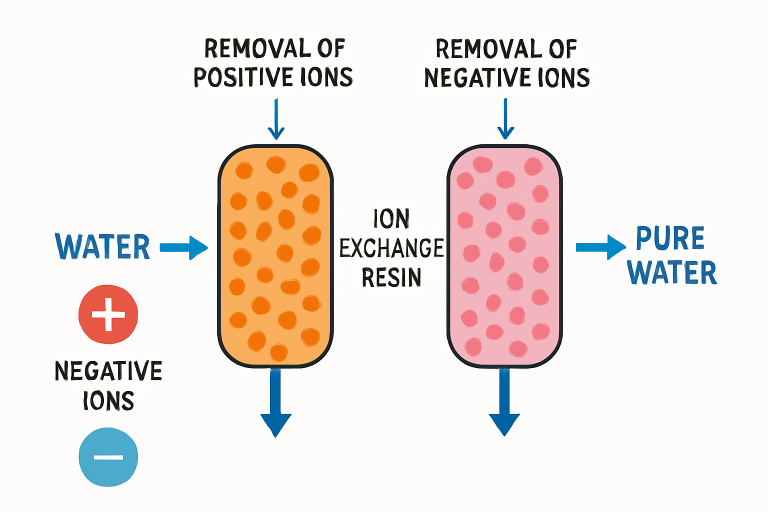
The underlying science consists of passing water through resin beds containing charged particles. These resins attract and trap ions, replacing them with hydrogen and hydroxyl ions, which in turn combine to form pure water. This capacity to target both cationic and anionic impurities enables a comprehensive approach to achieving high purity levels that are not possible with other singular filtration technologies.
The Role of Ion Exchange Resins
At the heart of deionization are the ion exchange resins—tiny, porous beads that are chemically engineered to target and remove specific ions from water. There are two primary types of resins:
- Cationic Resins: These exchange positively charged ions such as calcium, magnesium, sodium, and iron with hydrogen ions.
- Anionic Resins: These replace negatively charged ions, including chloride, sulfate, nitrate, and bicarbonate, with hydroxyl ions.
Water passing through these resins undergoes a process in which unwanted ions are exchanged, resulting in a reduction of total dissolved solids (TDS). This significantly enhances water resistance, providing a measurable indication of its purity and suitability for high-end industrial applications. The customizable nature of ion exchange beds enables the development of tailored systems that specifically address local water quality concerns, further enhancing the reliability of industrial water solutions.
Electrodeionization: A Continuous Approach
Electrodeionization (EDI) represents a significant advancement over traditional ion exchange, combining the principles of ion exchange with an electrically driven regeneration mechanism. EDI systems utilize both resins and electrically active membranes to remove ionic contaminants continuously, eliminating the need for manual intervention or chemical regenerants.
Traditional deionization systems rely on periodic chemical regeneration, which can interrupt production and introduce hazardous byproducts. EDI, on the other hand, eliminates these interruptions—allowing for uninterrupted water purification and thus greater productivity and efficiency. This is particularly beneficial in settings like pharmaceutical manufacturing and chip fabrication, where even minor fluctuations in water quality can disrupt process consistency.
For an in-depth exploration of EDI’s advantages, resources such as Morui Water provide analytical insight into industry best practices and the evolution of water treatment technology.
Applications of Deionized Water
Deionized water is foundational across a diverse swath of industries:
- Pharmaceutical Manufacturing: Deionized water is crucial in the production of injectable solutions, dissolving powders, and other high-purity applications that must comply with stringent regulatory standards.
- Electronics Production: The manufacture of integrated circuits requires water free of ionic contaminants to safeguard delicate wafer surfaces against conductive and corrosive particles.
- Power Generation: High-purity water reduces scaling in high-pressure boilers and turbines, preventing the buildup that can alter heat transfer rates or prompt system failures.
Each industry has a unique set of water purity requirements, and the reliability of the ion exchange and deionization systems separates leading operators from the rest of the market.
Maintenance and Monitoring
Reliable deionization systems hinge on consistent maintenance and diligent monitoring. Operators should establish a routine schedule that includes:
- Frequent assessment of water resistivity or electrical conductivity to immediately detect shifts indicating the presence of dissolved ions.
- Regular inspection and replacement of ion exchange resins are necessary to prevent efficiency losses and ensure continuous operation.
- Systematic monitoring of performance metrics, including flow rates, pressure drops, and EDI module functionality, to proactively address anomalies.
Well-maintained systems not only ensure water quality but also help prevent costly downtime or emergency repairs, thereby securing the integrity of sensitive production environments.
Environmental Considerations
Conventional deionization has historically relied on chemical regenerants, presenting concerns regarding disposal and handling. EDI technologies significantly reduce these environmental liabilities by utilizing an electric field to rejuvenate resins, thereby eliminating hazardous waste streams from chemical processes. This shift aligns with growing industrial commitments to sustainability and responsible resource stewardship.
Incorporating green technology in water purification not only aids compliance and reduces regulatory risk but also elevates corporate social responsibility frameworks.
Conclusion
Reliable access to high-purity water, achieved through deionization and ion exchange, underpins modern industrial production. Selecting the right approach, deploying advanced EDI systems, and prioritizing preventative maintenance together ensure ongoing compliance, operational efficiency, and environmental stewardship. In today’s regulatory and competitive landscape, investing in expert-level deionization systems is not optional—it’s a necessity.