
Health and Wellness
From Theory to Practice: Merging Digital Exam Prep with Hands-On CPR First Aid Learning

Introduction: The New Era of Medical Learning
Medical education is undergoing a transformation. Once dominated by thick textbooks and long classroom lectures, the field has embraced digital innovation—adaptive testing platforms, online simulations, and virtual anatomy labs have become integral to modern training. Yet, while technology can sharpen theoretical understanding, medicine remains a profoundly hands-on profession.
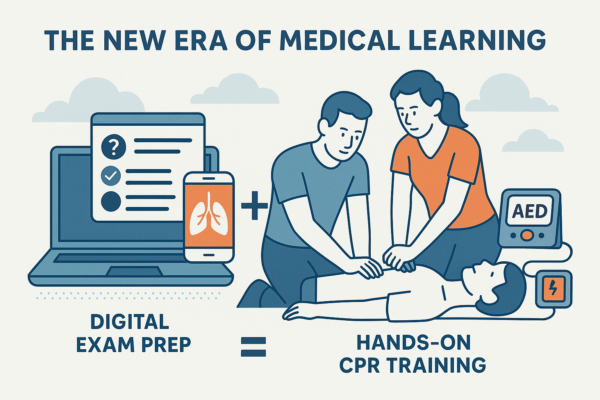
One domain where this balance between knowledge and skill is especially critical is emergency response. Understanding the science behind oxygenation or cardiac rhythms is of little value without the ability to act decisively during a cardiac arrest. The growing movement to integrate digital exam prep tools with hands-on CPR first aid training bridges this gap—preparing students not only to answer exam questions but to save lives.
The Digital Backbone: Smarter Learning Through Data
The backbone of modern exam preparation lies in data-driven digital tools. Platforms that once focused solely on rote memorization now employ artificial intelligence to personalize learning experiences. Whether it’s an MCAT study app, a nursing licensure review, or an emergency medicine refresher course, learners now benefit from adaptive testing, real-time analytics, and performance dashboards that reveal strengths and weaknesses.
Digital platforms also replicate clinical reasoning through scenario-based questions. For example, during MCAT prep, students might analyze a passage describing a patient with chest pain and infer physiological mechanisms and treatment priorities. This type of reasoning directly parallels the thought process required in CPR and first aid, where split-second assessments determine whether to begin compressions, call for help, or use an AED.
In essence, online learning teaches the why, equipping future clinicians with a foundation that informs the how. When integrated thoughtfully, these systems can transform raw information into applied clinical judgment.
Beyond the Screen: Why Practical CPR Training Remains Essential
While digital tools enhance theoretical competence, the physical and emotional aspects of emergency response cannot be simulated entirely online. CPR and first aid are inherently tactile skills—performed under stress, with precise physical coordination and an understanding of human cues that can’t be reduced to pixels.
Hands-on CPR training engages muscle memory and builds confidence through repetition. Learners develop an instinctive understanding of compression depth, rate, and rhythm. They also practice teamwork—rotating between rescuers, managing crowd dynamics, and utilizing equipment such as bag-valve masks or automated defibrillators.
Moreover, practical sessions expose learners to the emotional realism of emergencies. The controlled chaos of a simulated code, the urgency of time constraints, and the need to communicate clearly under pressure prepare trainees for the unpredictability of real-world crises.
Thus, while digital platforms teach what to do, physical training ensures students can actually do it.
The Power of Integration: Building Hybrid Learning Models
When digital preparation and practical training work together, the result is a hybrid educational model that amplifies both cognitive and kinesthetic learning. The key lies in thoughtful sequencing and alignment.
- Pre-Lab Digital Modules – Before attending a practical session, students can complete online modules that cover CPR theory, anatomy of the cardiovascular system, or emergency response algorithms. This flipped-classroom model ensures hands-on time is spent practicing, not listening to lectures.
- Simulation-Based Learning – High-fidelity simulations, powered by responsive manikins and digital interfaces, combine tactile experience with performance analytics. Students can see real-time feedback on compression depth and ventilation volume, turning physical practice into data-informed learning.
- Post-Training Assessment and Analytics – After in-person training, learners can take adaptive quizzes that reinforce decision-making skills, bridging memory retention with practical experience. Performance data can then inform educators about which areas require reemphasis in future practice sessions.
By creating a feedback loop between digital and physical environments, medical institutions foster continuous learning—students don’t just complete a course; they refine competence over time.
Real-World Example: The Hybrid CPR Curriculum
At several teaching hospitals and universities, integrated CPR training programs are already showing remarkable results.
One example comes from a partnership between a U.S. medical school and a digital health education company. The program began with an online course where students completed self-paced modules on cardiovascular physiology and emergency protocols. They were tested with adaptive questions and scenario-based cases that mimicked board-style questions.
Next, students participated in an in-person CPR first aid practicum using sensor-equipped manikins connected to the same platform. The system tracked hand placement, depth, and recoil, providing instant feedback on performance. After the session, learners returned to the digital platform to review analytics and answer reflection questions about how their theoretical understanding influenced their hands-on actions.
The outcome was impressive: students demonstrated higher retention rates three months post-training compared to those who attended traditional CPR classes alone. Perhaps more importantly, self-assessments revealed increased confidence and preparedness to perform CPR in real-world emergencies.
Benefits of Combining Digital and Hands-On Learning
- Enhanced Retention and Recall
When theory and practice are interwoven, students reinforce neural pathways through multiple learning modalities—visual, auditory, and kinesthetic. Studies have shown that blended learning enhances both short-term recall and long-term retention. - Improved Confidence and Autonomy
Interactive modules allow students to learn at their own pace before entering the physical classroom. This reduces anxiety and ensures that every participant arrives with a solid conceptual base. - Efficient Use of Time and Resources
Hybrid programs make in-person sessions more efficient. Instructors can focus on refining skills rather than re-teaching foundational theory, while students spend more time engaging in active learning rather than passive listening. - Objective Performance Measurement
Digital tools provide precise analytics that traditional instruction cannot. Metrics such as reaction time, question accuracy, or compression rate can be tracked and used to personalize feedback, helping learners identify specific areas for growth. - Scalability and Accessibility
Digital preparation enables institutions to scale CPR and first aid education to larger groups without compromising quality. It also provides opportunities for remote learners or professionals with limited access to in-person sessions to stay updated through blended learning modules.
Challenges and Considerations
Despite its many benefits, merging digital and practical training presents challenges.
- Overreliance on Technology: Students may equate digital mastery with clinical competence, forgetting that real-life conditions—such as fatigue, noise, or panic—cannot be replicated online.
- Consistency of Quality: Not all digital tools are created equal. Poorly designed apps or outdated simulations can create misconceptions or oversimplify complex concepts.
- Instructor Training: Educators must learn to interpret digital analytics and integrate them effectively into practical sessions.
- Assessment Balance: Over-testing can cause fatigue; striking a balance between assessment and application is crucial for engagement.
Successful integration requires collaboration between educators, technologists, and accrediting bodies to ensure both rigor and relevance.
Looking Ahead: The Future of Hybrid Medical Training
As healthcare continues to adopt technology, the distinction between digital learning and practical training will become increasingly blurred. Virtual reality simulations, wearable biometric sensors, and AI-driven feedback are already reshaping emergency medicine education.
Imagine donning a VR headset to practice CPR on a virtual patient whose vital signs respond dynamically to your actions, while real-time analytics track your decision-making and motor accuracy. This level of integration is not science fiction—it’s the emerging standard for a new generation of healthcare professionals.
By blending the precision of technology with the human touch of hands-on training, medical education can produce clinicians who are not only knowledgeable but also agile, empathetic, and ready for any emergency.
Conclusion: Where Knowledge Meets Action
Medicine thrives at the intersection of knowledge and compassion, theory and practice. Digital learning platforms have revolutionized the way students acquire information, but true clinical excellence is proven in the field, where actions matter most.
Integrating digital exam preparation with hands-on CPR and first aid training transforms learning into a complete cycle—students first understand, then apply, and finally refine. Through this balanced approach, the next generation of healthcare providers won’t just know how to save a life—they’ll be prepared to do it with confidence, precision, and heart.
I’ve done both online prep and hands-on CPR refreshers, and the combination honestly makes a huge difference. The digital modules help you understand the why, but nothing prepares you for a real emergency like physically practicing compressions and timing under pressure. Muscle memory matters more than people think. I volunteer at a senior center, and after reading a bunch of life alert reviews, I realized how often fast response truly saves lives.
I am delighted to announce my successful completion of the NCA AIIO (Artificial Intelligence and Intelligent Operations) Certification examination with outstanding results. The exceptional preparation materials and practice resources from ExamsMirror.com were instrumental in my achievement, providing me with the comprehensive knowledge and confidence required to excel in this important AI operations certification.
Smart savings for smart goals:
Understanding Viramchinh ki paribhasha is important for clear and meaningful writing. Proper use of punctuation marks helps readers understand sentences correctly and improves overall communication skills.
The topic Sangya ki paribhasha or bhed is very useful for understanding Hindi grammar. It clearly explains the meaning of nouns and their different types with simple and practical examples.