
Finance
Essential Information on Canadian Tax Slips for 2026

Key Takeaways
- Familiarize yourself with different tax slips to ensure accurate tax filing.
- Be aware of the issuance timelines for each slip to avoid delays.
- Utilize available resources to access and manage your tax documents effectively.
Table of Contents
- T4 Slip: Statement of Remuneration Paid
- T4A Slip: Pension and Other Income
- T5 Slip: Statement of Investment Income
- T3 Slip: Statement of Trust Income Allocations and Designations
- T4E Slip: Statement of Employment Insurance and Other Benefits
- T5007 Slip: Statement of Benefits
- T5018 Slip: Statement of Contract Payments
- Accessing Your Tax Slips
- The Importance of Waiting for All Slips
- Conclusion
Filing taxes in Canada involves managing various forms and documents, each serving a unique purpose to help the Canada Revenue Agency (CRA) assess your obligations. Among these, tax slips are crucial. Familiarizing yourself with key slips, such as the T4, and understanding how T5 tax slips work can help ensure your tax return is both complete and accurate. These documents reflect the income you have earned and the deductions or benefits you have received throughout the year, making them essential to your annual tax responsibilities.
Understanding when tax slips are issued, what each slip contains, and how to manage them can prevent costly mistakes or delays during the tax season. The better you know your way around these documents, the smoother your filing process will be. Taxpayers who keep organized records and utilize modern tools to access their slips often find they avoid last-minute scrambles and errors.
Most Canadians will encounter several types of slips, whether through employment, investments, or the receipt of government benefits. For each type, clear deadlines exist by which organizations must provide the appropriate documentation so filers can meet CRA requirements on time. By taking a proactive approach, you can avoid penalties and ensure your filings are accepted without unnecessary complications.
To manage your tax documents effectively, consider registering for the CRA’s online services. These enable you to securely view and download your slips, track submissions, and access important tax information year-round. This reduces dependency on mailed documents and helps you keep everything organized in one easily accessible location.
T4 Slip: Statement of Remuneration Paid
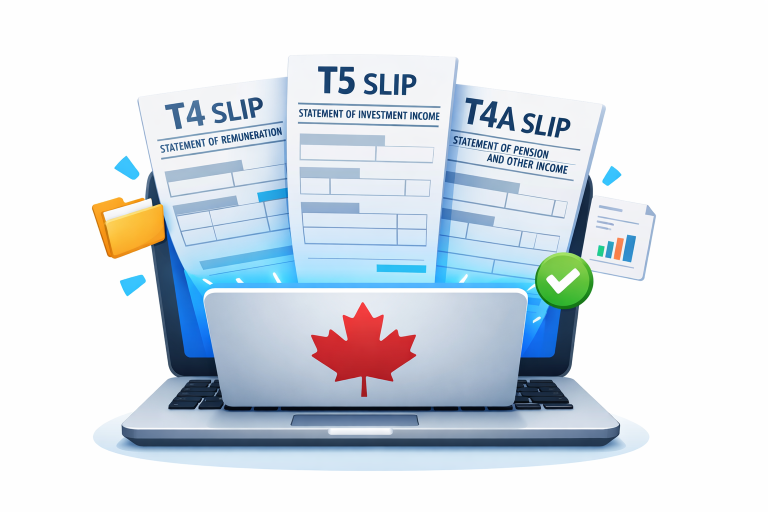
The T4 slip is a standard form provided by employers summarizing the income earned and all statutory deductions made throughout the year. This includes wages, salaries, bonuses, and any tax withheld at source. Employees need to receive their T4 slips no later than the last day of February each year. Review your T4 carefully to ensure it matches your pay stubs, as errors can affect your calculations and potentially lead to issues with the CRA.
T4A Slip: Pension and Other Income
The T4A slip covers a broad range of income types not directly related to traditional employment, such as pensions, annuities, fees for services, scholarships, or payments from registered educational plans. Financial institutions, pension plan administrators, or trustees generally provide these slips by the end of February. Reporting all relevant T4A amounts is essential, as unreported or misreported income can result in penalties and a reassessment of your tax return.
T5 Slip: Statement of Investment Income
The T5 slip is issued for interest, dividends, and some types of foreign income from non-registered investments. Banks and financial institutions must send these to investors by the end of February. It is crucial to include every T5 slip in your return because missing investment income can trigger a review or adjustment by the CRA. For more information about T5 slips, you can refer to Questrade’s guide on T5 slips.
T3 Slip: Statement of Trust Income Allocations and Designations
The T3 slip is generally provided to investors who own units in trusts or receive distributions from mutual funds. It reports interest, dividends, and capital gains paid to beneficiaries. Since trust income calculations can be more complex, T3 slips are usually issued later, with a deadline at the end of March. Ensure these are factored into your tax return, as trust-related income is often overto view and download slips securelyoyment Insurance and Other Benefits
If you have received Employment Insurance (EI) or other federal benefits paid through Service Canada, you will get a T4E slip. It details the gross amount of benefits paid to you and any taxes deducted from those payments. Like other forms, T4E slips are typically available by the end of February. Monitor your correspondence with Service Canada closely to avoid losing track of these documents, especially if you moved during the year.
T5007 Slip: Statement of Benefits
The T5007 slip is issued for reporting certain provincial or federal social assistance payments, including workers’ compensation and specific other benefits. These amounts must be recorded even if they are not taxable, as they may affect other credits or deductions. Typically, these are available by the end of February so that you can report benefits accurately.
T5018 Slip: Statement of Contract Payments
Particularly in the construction industry, businesses use the T5018 slip to declare payments made to subcontractors. If you are a contractor or subcontractor, you are required to issue or receive this slip by the end of February. This helps ensure the appropriate parties report contracting income, preventing tax avoidance or underreporting.
Accessing Your Tax Slips
While many tax slips are mailed directly, a growing number of organizations provide digital versions. If you do not receive a slip by its expected date, contact the issuer right away, whether it is your employer, your benefits provider, or a financial institution. The CRA offers electronic access via its login services platform, allowing you to securely view and download slips. This is a fast and reliable way to track your documents and avoid missing forms during tax time.
The Importance of Waiting for All Slips
Filing your tax return too soon, before all slips have arrived, greatly increases your risk of errors, omissions, and subsequent reassessments by the CRA. Waiting for every appropriate slip ensures the information provided is accurate, helping you claim all the credits, benefits, and deductions you deserve. Adopting an organized approach and verifying that all slips match your expectations can streamline the entire process.
Conclusion
Staying informed about the types and issuance deadlines of Canadian tax slips is one of the best ways to ensure a straightforward and stress-free filing season. Take advantage of digital resources, check the information on every slip, and never rush your tax return. This will help you meet CRA requirements with confidence and accuracy.