
Finance
What to Do When No One Is Managing Your 401k: 6 Steps to Take Control

You log into your old 401(k) and the balance reads $0.00. The portal feels foreign, emails bounce, and you’re now searching “missing 401k account.” Breathe. In most of the roughly 32 million forgotten accounts counted in a 2025 study, the money was simply moved or parked in cash – not stolen. The real danger is drift: no one is steering the investments or telling you where the recordkeeper went. This guide walks you through six steps: locating the account, auditing what it holds, choosing where it should live, moving the money without avoidable taxes, picking a management system you will actually use, and turning contributions back on so every dollar keeps working for you.
1. Pinpoint Where the Account Lives and What “Unmanaged” Really Means
Administration and investment: two different jobs
When people say a 401(k) is “unmanaged,” they usually mash two problems into one sentence.
The first is administration: the legal side, which means keeping records, mailing statements, filing Form 5500, and making sure money moves only when plan rules allow. A plan administrator or recordkeeper handles those chores even after you leave the company.
The second is investment management: choosing funds, rebalancing, and deciding whether to park cash or stay invested. In most workplace plans you hold that steering wheel unless you have hired a professional or enrolled in an automated service.
The confusion starts because the same website shows both functions. One day the portal changes logos, your balance disappears, and it feels like the whole ship sank. In reality the custodian still safeguards the assets while the investment mix simply waits for new instructions.
Self-directed brokerage windows make the split starker still. They unlock thousands of tickers, but every trade, rebalance, and diversification call rests on your shoulders. You gain menu freedom at the cost of hands-on duty.
Keep this two-hat model in mind. It tells you whether a missing balance is an administrative breadcrumb trail or just an investment housekeeping chore.
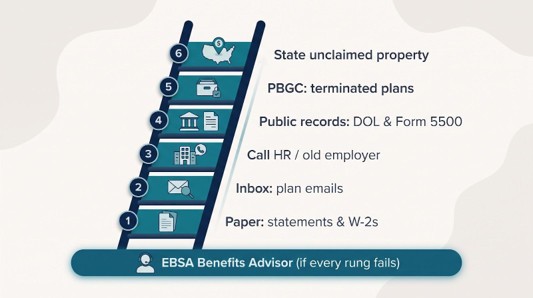
Trace the breadcrumbs: a simple locator ladder
-
- Paper first. Grab your last statement or W-2. It lists the plan name, recordkeeper, and a phone number that still works even if the logo changed.
- Inbox second. Search the employer’s name plus “401k,” “retirement,” “rollover,” “distribution,” or “converted.” Notices about system changes often hide in routine newsletters.
- Human third. Call the old HR line. Have the company’s legal name and your last work date ready; those two facts open more databases than your Social Security number.
- Public records.
-
- Run the Department of Labor’s Retirement Savings Lost and Found database, a SECURE 2.0 tool that began accepting plan data in late 2024. Not every plan has uploaded yet, so a blank result is not a dead end.
- If the trail is still cold, use the Form 5500 search to pull filings, plan numbers, and the administrator’s address.
- Terminated-plan check. If the plan shut down, search the PBGC Missing Participants Program directory, which now covers certain defined-contribution plans, including 401(k)s terminated in or after 2018.
- Unclaimed property last. Still nothing? Enter your name into your state’s unclaimed-property site; small involuntary cash-out checks sometimes land there.
If every rung fails, file a help request with an EBSA Benefits Advisor. The agency returned more than $468 million to workers through informal complaint resolution in fiscal 2025 alone. Work the ladder in order and you will usually answer the only question that matters: Who is holding my money today?
Zero balance? Do a quick forensics check before you panic
The screen flashes $0.00 and your stomach drops, but a blank dashboard is a clue, not a verdict.
- Open the transaction log. Scroll past the summary and look for keywords such as “transfer,” “conversion,” or “distribution.” A single outflow on one date usually means the money moved (not vanished).
- Call with evidence in hand. Phone the recordkeeper, read the exact line item, and ask where the funds went, on what date, and by check or wire. Write down the receiving institution and reference number; those breadcrumbs power the next call.
- Consider the small-balance rule. Plans may push out vested accounts worth up to $7,000 without your consent. Anything above $1,000 and below that ceiling is generally swept into an automatic rollover IRA if you do nothing, according to the 2026 IRS bulletin on SECURE 2.0 guidance.
- Check your mailbox and unclaimed-property site. If your balance once hovered under that threshold, look for a welcome packet from an unfamiliar IRA provider or a small cashier’s check that bounced back to the state.
- Rule out a recordkeeper migration. When employers change vendors, the old portal can show zero overnight while the new login takes days to activate. A quick call to HR or the plan’s 800-number usually confirms the hand-off.
Bottom line: gather timestamps, follow the trail, and decide whether the next move is a locator call, a rollover request, or simply waiting for the new portal to light up.
2. Audit the Balance, Investments, Fees, and Tax Buckets
Collect the paperwork that tells the truth
Before you decide whether the account is overpriced or tax tricky, gather proof; most of it sits right in the portal.
- Latest quarterly or annual statement. Shows total and vested balances, current investments, any outstanding loan, and recent activity.
- Summary Plan Description (SPD). According to the Department of Labor, ERISA requires the administrator to furnish a copy within 30 days of a written request.
- Participant fee disclosure (ERISA §404a-5). Look for recordkeeping or “former-employee” charges that may start after you leave payroll.
- Distribution or rollover notices issued at separation, plus any prior Form 1099-R or Form 5498; these flag tax buckets you must track.
- Beneficiary confirmation and loan statement if a balance is outstanding.
If the administrator misses that 30-day window, ERISA section 502(c)(1) exposes the plan to a penalty of up to $110 a day under 29 CFR 2575.502c-1. The paper trail you build now supports every fee check, tax move, and beneficiary update that follows.
Turn raw statements into a one-page fact sheet
Next, turn those PDFs into clear action points. Open a blank sheet and copy only what drives decisions:
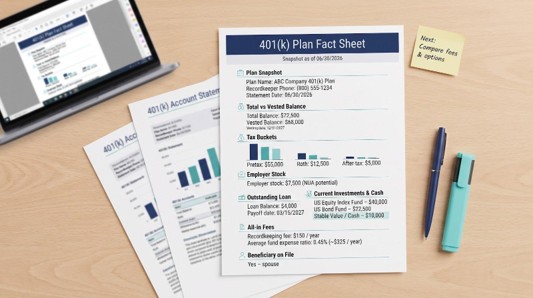
- Plan snapshot. Plan name, recordkeeper phone, statement date.
- Total vs. vested balance. Any gap usually reflects employer dollars still on a vesting clock; note the exact vest-by date.
- Tax buckets. List pretax, Roth, and after-tax amounts on separate lines. Mixing them during a rollover can trigger surprise taxes.
- Employer stock. Net unrealized appreciation treatment can cut the tax on highly appreciated shares, but only if the entire balance leaves the plan in one taxable year after a qualifying event and the shares come out in kind. Rolling those shares into an IRA destroys the break permanently, and on a small holding it is rarely worth electing.
- Outstanding loan. Record the balance and payoff date. A loan in good standing that is offset when you leave the plan is a qualified plan loan offset, and you can roll that amount over as late as your tax-return due date including extensions, so the tax bill is avoidable if you act.
- Current investments and cash. Jot each fund or money-market line; idle cash signals lost growth.
- All-in fees. Note the recordkeeping fee and each fund’s expense ratio in dollars, not just percentages.
- Beneficiary on file. A 60-second check avoids future probate headaches.
Finish this single page and you will know where every dollar sits, which tax silo it occupies, and what it costs to keep it there, turning the next stay-or-roll decision into a calm calculation instead of a guess.
Translate percentages into real money and spot idle cash
A fund that charges 0.85 percent feels harmless until you do the math. On a $70,000 balance, that “whisper” drains about $595 a year. The Department of Labor frames the long-term cost the other way round: one extra percentage point in annual fees cuts the ending balance by about 28 percent over 35 years, turning $227,000 into $163,000. Run the same calculation for recordkeeping charges or any flat “former-employee” fee, then total everything; that figure is your all-in drag.
Next, scan the statement for cash lines such as money market, stable-value, or settlement fund. If more than a token amount sits there, the account is idling in first gear. Industry research finds that rollovers left in cash after job changes can erode growth over time.
Idle cash is a quiet drag, and it hits hardest when inflation runs hot: a balance parked in a money-market or stable-value line is not participating in the growth the rest of your plan is counting on.
If your plan offers a self-directed brokerage window, brokerage account management inside that window is one route for redeploying idle balances into a diversified mix. Brokerage windows are a minority feature, so check your plan documents before assuming you have one.
Finally, check for overlapping funds. Three target-date funds from different years often own the same indexes, so you pay multiple expense ratios for the same exposure.
Need help with the math? Enter each fee and cash amount into the free Compound Interest Calculator at Investor.gov to see how much growth they siphon over your time horizon. Ten focused minutes can turn invisible percentages into visible dollars and often spark the motivation to act.
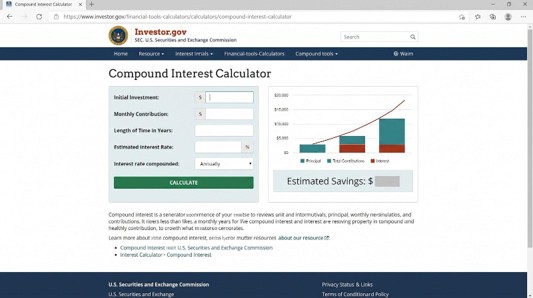
Investor.gov Compound Interest Calculator official tool screenshot
3. Should You Leave the Money, Move It to a New Plan, or Shift to an IRA?
Begin with the four forks in the road
After you leave a job, every old 401(k) lands in one of four IRS-recognized categories. Each path carries its own fees, rules, and protections.
- Leave the money in the former employer’s plan. You keep ERISA creditor protection and any institutional-price funds already in the lineup, but former-employee fees can appear.
- Roll it into your current employer’s plan, if that plan accepts incoming money. Consolidation trims logins and preserves Rule-of-55 penalty-free access once you qualify.
- Roll it into an IRA. You open a wider menu of investments and potential Roth strategies, yet lose ERISA’s federal shield and must monitor each new fee yourself.
- Take a taxable cash distribution. Simple today, costly tomorrow; the balance becomes ordinary income and usually triggers a 10 percent penalty before age 59 ½.

Treat these options as levers to balance cost, access, and risk rather than “right or wrong” judgments. The next section compares them side by side so math, law, and your timeline drive the decision.
Weigh the features, not the hype
A slick brochure means nothing if the numbers and rules do not work for you. Compare each lever on your fact sheet:
Fees. An old plan’s institutional funds can beat retail IRAs, but some plans tack on flat “former-employee” charges. Line up the all-in drag you calculated earlier against your current plan’s fee sheet and a real IRA quote. Flexibility is pointless if it costs more.
Legal protection. Balances inside an ERISA 401(k) enjoy broad federal creditor shielding. Traditional and Roth IRAs are generally protected in bankruptcy only up to about $1.7 million under 11 U.S.C. §522 (n), and non-bankruptcy creditor rules differ by state. If you face lawsuit risk, that shield may tip the scales.
Early-access rules. Leave or retire in the year you turn 55 and the Rule of 55 lets you tap that 401(k) without the usual 10 percent penalty. Roll to an IRA and the door stays shut until age 59 ½.
Tax strategy. Moving pretax dollars into a rollover IRA can trigger the pro-rata rule for anyone using a backdoor Roth. Roth sources belong in Roth destinations, and highly appreciated employer stock may deserve its own NUA game plan. Match each bucket to the right landing zone before you sign transfer papers.
Investment menu. IRAs promise broad choice, but choice means homework. A lean employer menu can cover every core asset class in half a dozen low-cost funds. More funds rarely fix an allocation problem; they mostly make mistakes easier.
Give each factor a one-to-five importance score on your fact sheet, multiply by how well each destination meets the need, and add the columns. The destination with the highest total is your front-runner, chosen by math and law, not marketing.
Guard against conflicted advice before you sign transfer papers
A glossy rollover kit or a warm voice on the phone is still a sales pitch unless the person accepts fiduciary duty. The Department of Labor confirmed this on March 20, 2026, when it published a technical amendment implementing the courts’ vacatur of the 2024 Retirement Security Rule. Because that rule never took effect, the older five-part test – which often treats one-time rollover recommendations as non-fiduciary sales – has applied throughout.
Send these questions – by email or letter – before your money moves:
-
- Will you acknowledge fiduciary status for this recommendation and put it in writing?
- Exactly how will you and your firm be paid if I roll over, and how will you be paid if I stay put?
- Which plan features would I give up, such as Rule of 55 access, ERISA creditor shield, or loan options, by moving?
- Can you advise me on the existing 401(k) without transferring the assets?
- Have you compared my old plan, my current plan, and an IRA side by side using dollars, not percentages?
- Will any part of your compensation depend on the products chosen after the rollover?
- May I review your Form CRS, Form ADV, and your record on FINRA BrokerCheck and the SEC’s Investment Adviser Public Disclosure site?
- Who will pay trading costs, account fees, or wrap fees after the move?
- If I decide not to transfer, will you document why staying put is in my best interest?
A true fiduciary answers without hesitation. Keep their written replies with your rollover paperwork; you may never need them, but if you do, they are priceless.
4. Move the Money Without Triggering Avoidable Taxes
Choose a direct rollover and label every tax bucket
Pick direct over indirect. In a direct rollover, the check is payable to “ABC Bank FBO Jane Doe” (for your benefit). No tax is withheld, and the money never touches your personal account, so nothing counts as income.
In an indirect rollover, the check is written to you and the plan withholds 20 percent for taxes. You then have 60 days to redeposit the full amount, including the withheld cash; otherwise, the IRS treats it as a taxable distribution and adds a 10 percent penalty if you are under 59 ½.
Map each bucket before the check moves.
- Pretax 401(k) → traditional IRA or another pretax employer plan (tax-free)
- Roth 401(k) → Roth IRA or Roth account in a new plan (tax-free)
- After-tax contributions may go to a Roth IRA, while their earnings land in a traditional IRA – but only if the paperwork splits them
- RMDs cannot be rolled over. Separate them before you sign
- A loan offset at separation is a qualified plan loan offset, not a deemed distribution; you can roll the offset amount over as late as your tax-return due date including extensions
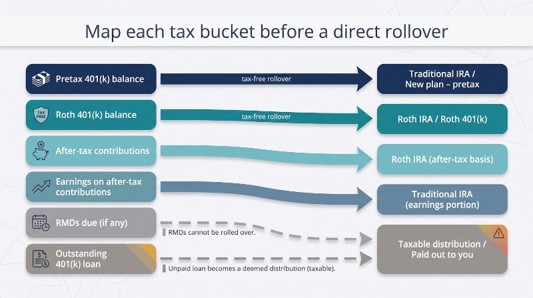
Send one clear letter of instruction that lists every source dollar and its target account; this step prevents paperwork errors and unexpected taxes.
Track every dollar until it’s invested, not just transferred
- Keep a simple log. Note the request date, gross amount, pretax and Roth splits, check or wire number, and the receiving account number.
- Match both sides. The old plan should show the outbound amount within a day or two; the new custodian should display identical uninvested cash within about a week.
- Invest immediately. Industry research shows that about two-thirds of rollover clients who landed in cash never realized their money was uninvested, a mistake that can cost years of growth. Place the trade as soon as the cash posts.
- Sweep for stragglers. After the next dividend cycle, log back into the old portal. Late dividends, corrective credits, or residual payroll deposits can appear; request a second direct rollover if even a few dollars remain.
- Archive proof. Download the final zero-balance statement, the new account confirmation, and your tracking log in one PDF folder. Future you, and any auditor, will have a clean trail.
Daily alerts from the new custodian’s app make this checklist almost automatic – but only if you turn them on before the money moves.
5. Choose a Simple Investment and Management System
Start with the lightest tool that still gets the job done
Ask one blunt question: How much time will I realistically give this account each year? Match your answer to a rung on the management ladder:
- One-fund autopilot. A single diversified target-date or balanced fund handles asset mix and rebalancing. Studies show that target-date investors who “set it and forget it” often earn risk-adjusted returns similar to more complex self-directed portfolios, without extra homework.
- Two- or three-fund core. Pair a total U.S. stock index with a broad U.S. bond fund, or add an international index for global coverage. Rebalance once or twice a year. Long-running research finds that an asset-allocation policy like this explains roughly 90 percent of how a portfolio’s returns vary over time, and it costs a fraction of a percent in fees.
- Advice-only check-ins. Pay a flat or hourly fee for a custom allocation map, tax-bucket strategy, or retirement-income plan, not for someone to place trades every quarter.
- Full-time asset management. Consider this only if tax brackets, charitable goals, or behavioral coaching justify the cost. Turning the typical 1 percent of assets into dollars means about $600 a year on a $60,000 rollover, so be sure the value you receive is greater than the drag you accept. Employer plans sometimes offer a robo or managed-account tier at lower cost; compare before signing.
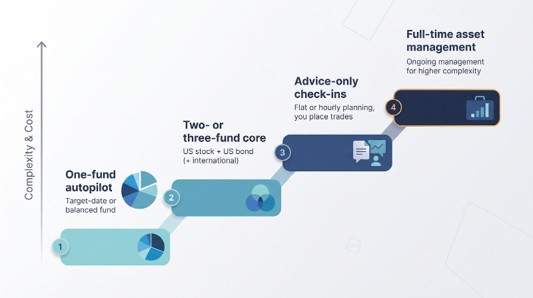
Move up the ladder only when added complexity solves a real problem. Moving back down later can be harder once habits and contracts set in.
6. Restart Contributions and Put the Account on an Annual Review Schedule
Re-engage the new workplace plan before inertia steals momentum
Switching jobs often means earning more but saving less. A study of nearly 800 workplace plans found that the median switcher enjoyed a 10 percent pay bump yet cut retirement saving by 0.7 percentage point.
Here’s how to dodge that trap during your first week on the new portal:
- Set (or raise) your contribution rate. Check that the default did not drop to 3 percent; move it back to your prior level or higher.
- Turn on automatic escalation. A 1-point annual bump keeps raises from disappearing into lifestyle creep.
- Check the match formula and vesting clock. If the match starts after 12 months, consider adding that gap to your own deferral so total saving stays level.
- Pick traditional vs. Roth consciously. Many plans default to pretax; switch to Roth if it fits your tax map.
- Note whether the plan accepts roll-ins. Even if you leave the old balance parked for now, knowing the door is open simplifies future consolidation.
- Enable email or app alerts. Real-time nudges help you spot skipped contributions, menu changes, or new fees.
These ten minutes lock new dollars onto the same growth path your rollover just reclaimed.
Conclusion
An unmanaged 401(k) is almost never a lost 401(k). It is an account whose administration kept running while nobody made an investment decision for it. Work the six steps in order and the fog clears: you find where the money sits, you learn what it holds and what it costs, you pick a destination on the numbers rather than the sales pitch, you move it without handing the IRS a slice, you choose the lightest management system you will actually keep up with, and you turn fresh contributions back on. None of it takes special expertise. It takes a phone call, a single sheet of paper, and the willingness to finish the transfer instead of leaving the cash sitting in the receiving account.
This article is general information, not tax, legal, or investment advice. Plan rules, contribution limits, and federal thresholds change, and the right move depends on facts specific to you, so confirm the details with your plan administrator and a qualified professional before you sign anything.
I think this is a useful reminder that old retirement accounts still need attention, even when they are out of sight. I once found an account from a previous job that I had completely forgotten about, and sorting it out felt surprisingly satisfying. Since then, I check my retirement accounts a few times a year and keep all the login details together. While researching different investment options, I also came across lear capital reviews , which reminded me how helpful it is to compare choices before moving money anywhere. Having a simple system makes retirement planning feel much more manageable and less overwhelming.