
Business
A Guide to Mandatory Health and Safety Compliance for New Food Businesses

Most new food businesses treat health and safety compliance like a checklist to survive – something you rush through before opening day and hope you don’t hear about again. That’s the wrong way to think about it. The operators who build durable businesses treat compliance as infrastructure, not paperwork.
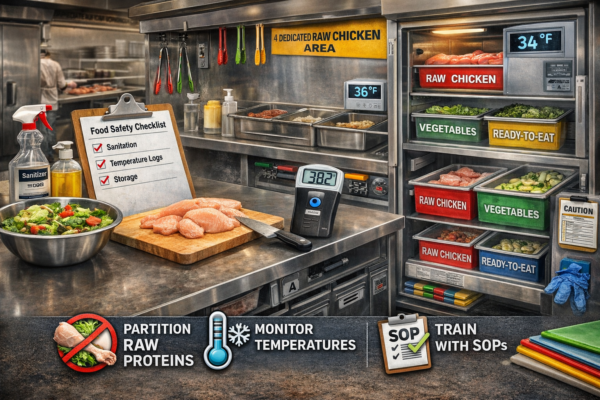
Build food safety into the physical space, not around it
The most significant error owners commit when outfitting a kitchen is approaching safety as an optional feature to include once all the fun stuff is in place. Cross-contamination isn’t the result of lazy employees; it’s the product of a poorly designed workflow.
Areas devoted to raw protein preparation must be partitioned – physically and ideally spatially – from ready-to-eat stations. That means separate cutting surfaces, dedicated utensils, and hopefully different parts of the kitchen which staff members aren’t shifting between with a quick glove change. When you’re designing the layout of your space, map the route raw chicken travels from the walk-in to the cook line. If it in any way, shape, or form comes near your salad station, go back to the drawing board.
Temperature is the second half of the layout-focused equation. Every new restaurant needs a cold chain management system, but how many are designed with integrated monitoring systems? Calibrated digital thermometers – not the back of your palm – should dictate the shelf-life of your product. The “Danger Zone” or the between 41°F and 135°F range where pathogens multiply at their fastest rate, is responsible for most foodborne illness cases. The CDC estimates the cost to the industry lies around $55.5 billion in medical bills, lost productivity, and lawsuits each year. That sum wouldn’t exist if temperature logs were standardized and “Potentially Hazardous Foods” (a.k.a. TCS foods) were monitored as they should be.
Log temperatures. Calibrate your thermometers. This isn’t an occasional assessment; this is a daily pre-service routine.
Turn inspections into an internal practice
Local health departments don’t publish their inspection criteria as a courtesy – they publish them because food safety works better when businesses know what’s expected. Most operators read the list once and file it. Smart operators use it as a training tool.
Run a weekly mock inspection using your local health department’s actual checklist. Assign someone to walk the kitchen with a clipboard and mark every potential violation. Fix it that week. When an official inspector arrives, you won’t be scrambling – you’ll already know what they’re looking at.
ServSafe certification matters here too. Having a certified food safety manager on staff doesn’t just satisfy a regulatory requirement in most jurisdictions. It also means someone in your building understands HACCP principles – the systematic approach to identifying biological, chemical, and physical hazards before they become incidents. That knowledge shapes how your team handles food every shift, not just when an inspector is present.
Document your Standard Operating Procedures. Written SOPs for receiving, storage, prep, and sanitation give you something to train from and something to reference when a new hire skips a step.
Align your operational permits early
Health permits, building approvals, and fire inspections don’t run on the same timeline, and they’re handled by different agencies. Treating them as a single “open the restaurant” checklist leads to delays that cost money.
Your Certificate of Occupancy, fire marshal inspection, and local health department approval each have their own requirements, inspectors, and lead times. The fire marshal will check your egress paths, occupancy limits, and whether your hood suppression system is properly installed and certified. That system needs to be serviced semi-annually once you’re open – it’s not a one-time sign-off.
On the beverage side, getting your liquor license is a separate legal process that sits entirely outside the health and safety permitting track, and it routinely takes longer than owners expect. If alcohol is part of your concept, that application needs to start early in the pre-opening phase, not after the kitchen passes inspection.
OSHA requirements don’t stop at the food
Many new restaurant owners look at food safety and think they have it covered. They likely don’t even consider occupational safety until someone gets hurt. But the reality is OSHA regulations apply to your staff, not just your kitchen practices.
This means having a documented chemical hygiene plan. A janitorial closet full of mystery chemicals is a big red flag. Every chemical cleaning agent in your building should have a corresponding Material Safety Data Sheet (MSDS) available. And the staff that handles those chemicals need to be trained on the location of those sheets, as well as the proper use of the chemicals. Personal Protective Equipment is not optional. Neither is training staff on when and how to use it.
Commercial kitchens are required to have a Class K fire extinguisher. This Class of extinguisher is specifically for fires in commercial kitchens using vegetable oils or animal fats. Many new builds or remodels will equip tenants with a Class ABC extinguisher because it’s a cheaper option and works on most small fires you’ll encounter in a kitchen. New restaurants often fail their inspection because a new local inspector asks for the Type K and they have to run out and buy one. It’s not hard to visually inspect the tag on your extinguisher as it’s brought in the back door.
Run toward the standard, not away from violations
The restaurant industry is known for overlooking compliance to some degree because margins are tight and rules are many. But that’s not an approach that leads to a sustainable business. Those that take it upon themselves to implement real systems (temperature checks, documented SOPs, manager training, ensuring your space is properly permitted) decrease their legal risk and create a workplace that people want to work in. That’s a competitive advantage, not an onerous additional task.
This guide does an excellent job of breaking down why health and safety compliance isn’t just a tick‑box exercise but a foundation for running a sustainable food business – something many startups underestimate. It reminds me of how seriously restaurants like Grill Point NYC – Mediterranean restaurant in New York City that’s been serving fresh, Glatt Kosher dishes since 2003 take their operational standards, from daily food safety practices to clean, well‑managed service, all of which contribute to long‑term success as much as following regulations does https://grillpointnyc.com/