
Business
Why Modern Commercial Signage Is Moving Away from Traditional Glass
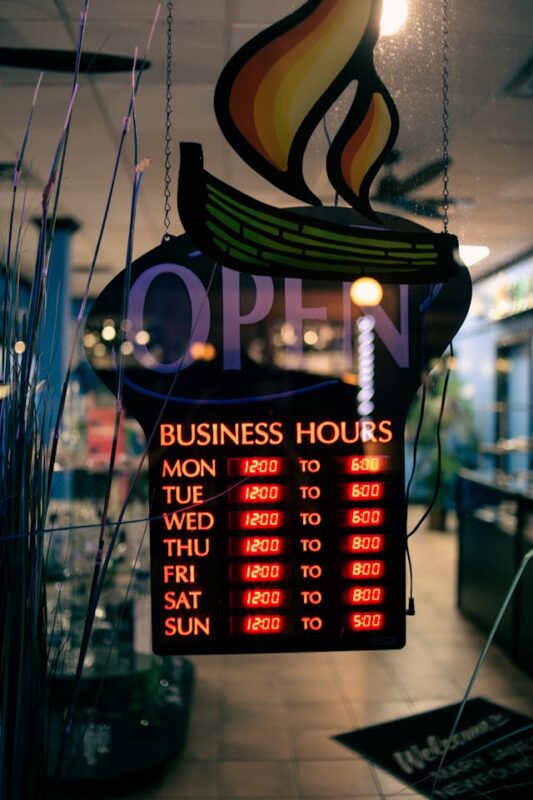
In the past, businesses used glass for commercial signage since there was no alternative that looked as good as glass signs or that maintained their printed quality. However, today, this is no longer the case. The fact is, the cost of glass signage to a business goes beyond its attractive appearance.

Weight Changes What’s Possible
One of the advantages of modern plastic substrates that people don’t talk about enough is how dramatically they reduce structural load. Glass is heavy. When you’re mounting a large illuminated sign on a cantilevered bracket above a shopfront, every kilo counts. Specifications go up, hardware costs more, and the number of suitable mounting positions decreases.
Switching to polycarbonate or high-grade acrylic changes that math. The load is substantially lighter, enabling fabricators to make larger signs that don’t require special mounting reinforcements. Architects and fit-out teams have more leeway in where they position signage, and owners end up with bigger, bolder signage in the optimum spot for about the same outlay.
This is particularly important in retrofitting scenarios, where you are updating the sign frame of an existing, glass-built structure to better reflect the client’s or tenet’s new visual requirements. Using a lighter substrate doesn’t just give the sign a facelift; it breathes new life into the frame itself.
What Total Cost of Ownership Actually Looks Like
A glass sign might appear cheaper in terms of the actual cost of the material in some instances. But when you take the full life-cycle cost into account, the comparison just doesn’t hold up.
Glass is especially prone to spider-web cracking through thermal stress. All materials expand and contract with heat changes, but glass doesn’t handle that process especially well compared to treated polymers. When the cracking process starts, there’s no fixing the sign panel; it has to be completely replaced.
With higher transport and installation costs at every turn, glass requires more packaging to protect it in transit, and specialist handlers and more of them to carefully bring it onto the site. A chipped or cracked sign panel that must be replaced before it’s even installed only adds time and cost as you wait for a new order to come in.
Treated modern acrylics and polycarbonates from a specialist supplier like Productive Plastics are precision-cut to spec, arrive with minimal breakage, and can often be installed with a smaller crew who don’t require the same handling barriers. Over five years, the cost of maintenance, replacement, and labour seldom comes out in glass’s favor.
Safety Isn’t a Small Consideration
When standard glass breaks, it snaps into sharp, jagged shards, with floor-flinging force in the case of overhead signage. Polycarbonate and acrylic break into dull-edged, circular fragments just millimeters wide (intentionally small to reduce injury potential further), meaning it’s highly unlikely sharp falling debris will injure a pedestrian, or a tire, when the sign falls directly on a car park space.
LED Technology Made the Switch Necessary
The transition to LED-illuminated signage prompted a material shift that we don’t give enough credit. Glass diffusers never anticipated LED output. LED modules are a high-intensity point-source light that is transmitted through the glass, creating hot spots which are bright enough to read a newspaper through, and which make a sign look cheap, and uneven, no matter how well that sign was designed and built.
The plastic diffuser panel used in this LED sign is engineered light managed solution. The properties of the material and profile of the panel work together to soften that high-intensity light source and distribute the light much more evenly across the face of the sign. The hot spots are eliminated naturally, without the facing plastic having to be made thicker, or the LED modules spaced further apart. The light just shines more evenly and efficiently along the length of the panel.
The Sustainability Question is More Complicated Than it Looks
Glass has sort of a deserved reputation of being the right environmental choice because it’s recyclable and made from natural ingredients. It’s part truth, but that’s not the whole story.
Glass manufacturing requires a lot of energy. It uses more fuel to transport because it’s heavier. When glass breaks, in transit, in installation, or in the field, it goes to landfill because broken glass cannot be easily reintroduced into the production process.
Also, many of the modern signage plastics are recyclable now and can be reintroduced to the fabrication streams at their end of life. So, a 10-year-old sign panel that never needed anything replaced or didn’t crack starts to look a whole lot greener than one that was replaced twice in that same timeframe. Longevity is part of sustainability, and here glass takes a hit.
This isn’t a decision that these businesses making the switch to polymer-based signage are making primarily for the environment. They are doing it because the numbers work. But it is a defensible decision for sustainability, and, as a nice benefit, worth noting.
Glass is also hard on brand consistency. Brands only look good when the signage is good between replacements, and glass makes that harder than it needs to be.
Great insights on how commercial signage is evolving – especially the shift toward cleaner, more modern materials and away from traditional glass-heavy designs. It’s interesting how branding, visibility, and durability are now all driving design choices in very different ways. Even in everyday environments like a pawn shop, you can really see how signage impacts first impressions and customer trust.