
House and Home
How to Arrange the Living Room: Easy Design Tips

The living room is a multifunctional space, and Peak Residential Management warns, arranging it is not an easy task. Today we will figure out how and what to furnish the living room, not to arrange in it a warehouse of forgotten items, competently and stylishly allocate the furniture, and take into account all the nuances of shape and size of the room where it will be located.
Starting With the Project
Any repair or rearrangement in the apartment cannot be as random as gambling at Woo Casino Canada. So this process should begin with a plan. The plan of the room and the implementation of the planned work in it will help to take into account all your needs and at the same time not to spend too much money.
If you do not know how to use programs for drawing, this is not a problem because you can always draw a plan by hand. It is necessary to measure the room with a tape measure and draw the room to scale. When choosing furniture on the website or in a store, write down the dimensions to insert them into your drawing. Don’t forget to indicate where the window is located and which way the door opens – that way, you won’t miss the placement and block the aisles. There should be about 70-90 cm of space between pieces of furniture for comfortable movement.
Deciding on the Functionality
Next, you must figure out what you will do in the living room. Besides the fact that this area can serve as a place to rest, the living room can also be a workspace, arrange a place for children to play, or put a cot for the pet. Write down in a column all the functions that you think the living room should perform – it greatly depends on the furniture you furnish it with.
If the living room will perform several functions, it is better to zone it. It means you should visually divide the space into several zones. This can be done with the help of lighting, the color of the walls and floor, and partitions in the form of shelves.
Planning the Space
There are three main types of living room layouts: symmetrical, asymmetrical, and circular. In any type of layout, it is important to determine the compositional center – everything else will line up around it.
A living room in the classic style is a suitable symmetrical layout. With this type of layout, the furniture is placed symmetrically for the compositional center – the sofa, an artificial fireplace, or a console with a mirror.
An asymmetrical layout is one in which there are no specific rules and regulations. The main thing is that the entire composition looks harmonious.
A circular type of layout involves lining up pieces of furniture around the compositional center, which can be a coffee table in the center of the room, a ceiling lamp, or, for example, a pouf.
Choosing Furniture
For those who use the living room for its direct purpose, we need a roomy sofa, a coffee table, and a TV set to receive guests. You can buy armchairs if the size of the room allows it. But remember that buying furniture sets and sets of furniture is no longer fashionable. Now, the trend is to buy furniture in different colors and textures. If there isn’t enough space, the poufs or comfortable chairs, which take up much less space, can help you. They are easier to move or hide on the balcony.
If you often take work home or have moved to a remote office and don’t have a separate office, the living room is a great place to put your workspace. You’ll need a desk and, understandably, a chair. And also there must be a properly chosen desk lamp. It has to be bright enough not to ruin your eyesight.
If you have young children, it is important to understand that they will not play quietly in their room while you sit in the living room. They will, of course, seek to get close to you. So it is worth taking care of this in advance – lay a warm and soft carpet, find a place to store toys, and put special protective pads on the sharp corners of furniture. Pay attention to the furniture’s materials – refuse glass-shattering surfaces in favor of wooden ones.
Selecting the Lighting
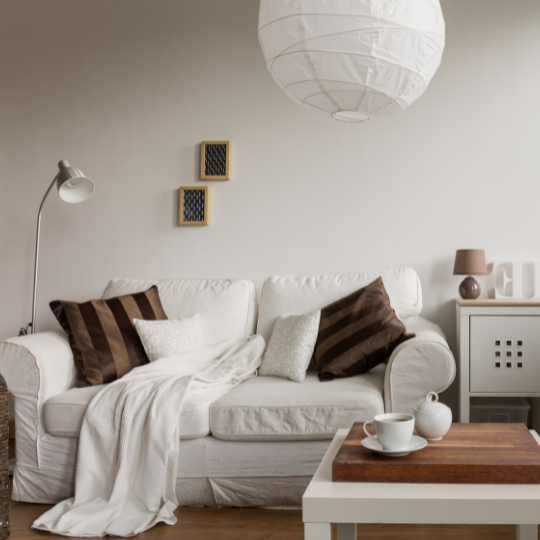
The lighting should be three-tiered in any space – it should consist of overhead ceiling light, wall, and table lamps. This is done to ensure that every corner of the room is lit, creating a feeling of comfort and visually increasing the space.
Hiding Unnecessary Things
Remember that the main rule is no unnecessary items in the room. Think in advance about where you will store things. For example, if you buy a folding sofa in the living room, you will catch two birds with one stone: you will have an additional sleeping place, and you will also get a place for storage in the sofa.
Look at hanging shelves if there is no space for a bookcase or a chest of drawers with souvenirs. You can put everything you need on them and leave the space airy to feel comfortable in the room.